
What is your worst day?
And does it define you?

“I don’t want to be defined by my worst day.”
She said it casually, painting her nails to avoid looking at the screen.
In the world of college essay writing, that statement prompts an easy follow-up. “Then, what do you want to define you?”
At seventeen, that’s a big part of the job. Trying to determine the human we want to represent on paper, the one that, of course, looks most attractive to college admissions officers, but also reflects some truth that feels sturdy.
It is one of the reasons I stay close to this age group, to this phase of life. It’s often the first time that 17-year old has the opportunity to fully form their own narrative. To determine how they want to describe themselves and what parts of their story matter most.
It’s a process I believe we keep repeating from thereon out.
But that follow up is also a side step; it allows us to avoid the other follow up question.
“But, does it? Does it define you? And if so, how?”
It was that question that stuck with me. Not the one I asked, the one that helped us build an outline for a Common App essay, but the other one. The one that likely leads to a more laborious place.
That is the question that unlocks where the work is.

I don’t know what my worst day is.
I tried to deduce it, to bullet point the most fucked up things that have happened in my life and work backwards. There’s a continuum of sad and painful and even obvious awful on the list. I have likely been shaped in big ways and small by most of them, but none of them, at least individually, seem to define me.
It’s the spaces between the bullet points that caught my attention. Every time I hit “Enter”, I thought about the person I was in the space between that horrible thing and the next. The times I was brave enough to work through the bad and the times I boxed it up instead. Where I found purpose in the pain and where I pretended there wasn’t any. Where action took up the slack because I couldn’t achieve acceptance.
My worst days are strung together by some of my worst periods, epochs of my life when I was not someone I recognize or care to remember, times I can’t touch because I’m too embarrassed not just by who I was, but more so by who I wasn’t.
There’s a pattern in those bullets, a stringing together that does define my life. I survive each hard thing with strength, sometimes in silence, and sometimes slinging foul language and off color jokes. But each time the next bullet point types itself on my page, I recognize the fall that’s coming in the space thereafter. I make it out, yes, but not as a better version of myself. My cavern of dark, dirty secrets follow a timeline.
Until recently.
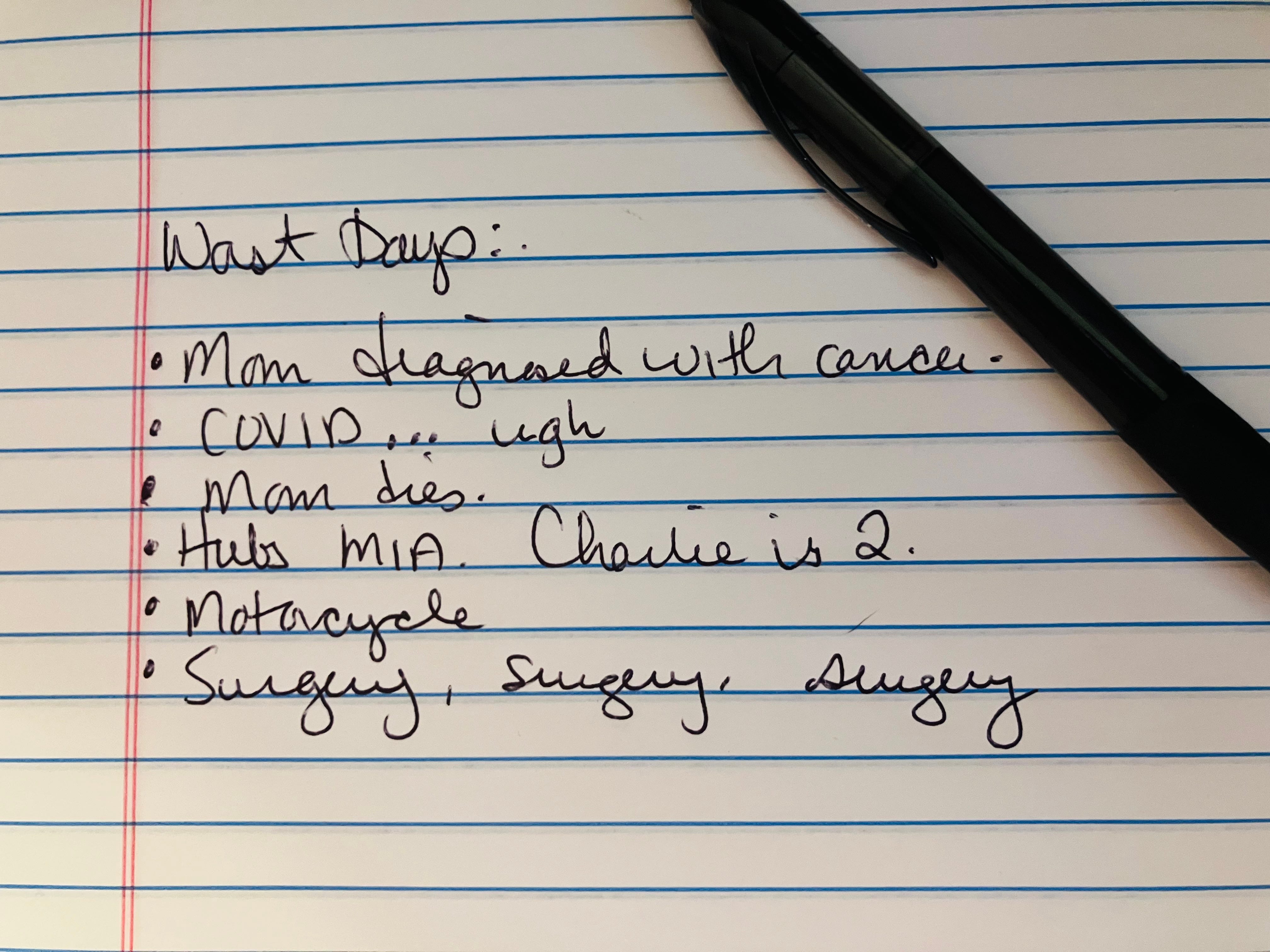
This is the list of my worst days in the past six years. Each one a body blow.
And in between, nothing.
I felt nothing.
And for the first time, I got scared that what would define me is not my worst days, but the nothingness in between.
That’s how and why I started writing again. Therapy helped me handle the anger after my Mom died but it couldn’t touch the absence of anything else. It was writing that finally helped me interrogate the empty space, to dive under the white noise filling my brain to the cesspool of emotion underneath.
And it was writing that gave me first the desire and then the strength to swim.

As I was thinking about the stories of redemption and resilience that I am often invited into in my line of work, I realized that many of these stories start with someone’s worst day. And how they have allowed it to define them…or not.
But what if, like me, your worst day isn’t so obvious? What if you haven’t been kidnapped, raped, incarcerated, almost died, or stood witness while the person you love most did? And what if, even if you have lived through one of those things, its not what you would list as your worst day?
What if, like the woman whose home was destroyed by the floods in Texas last year, your worst day isn’t the day the thing happened, but all of the days that came after? As she related to NPR, “As bad as the flood was, it was the easiest part of this entire ordeal.” I get that. She gets “credit” for the flood, but the flood was explainable, natural, shitty, but part of the deal. What came after - the lack of help, the isolation, the desperation - was incomprehensible, avoidable, and entirely unexpected. That was the worst part.
It made me curious what the people closest to me, those who have lived through some of my worst days with me, would name as their own?
So, I asked.
And in the asking, I realized that I know very little about the worst days of those I love most. And I know even less about how those days have shaped who they are, and who they aren’t, as a result.
I need more time to sit with those stories, to give them the space they deserve to air themselves.
And to deal with the complicated underbelly that’s lurking in this question. I know I’ve hit on something because each new question begets another. I’m just not sure where to go or what to do with the questions…or the answers. This feels worthy of sitting in, of allowing its sticky to get tacky before I rush to wash it off, close it up, or consider it done.
I’m getting good at sitting, as we learned last week, but at least now I have something to do.
The Joy Luck Club has always been a space for me to work out my own shit, but I don’t know that this one is a solitary endeavor. So, I’ll leave you with the question and invite you to share your answer. If you please, how you please, and only if it will be productive for you to do so. But, I hope you’ll share with someone. And maybe ask them the same.
“What is your worst day? And does it define you?”
This is so dense and full of good questions — your handwritten list and honest musings made me think of my own. I really resonated with the story about the woman who lost her home in the flood in Texas, and that the "worst" was all the days after. It was the lack of help, etc. For me, it has always been the many days after and the lack of accompaniment. There is a demarcation day — the event itself — but as Gabor Mate and others remind us, trauma isn't what happens to you; it's what happens inside you. And what happens inside is so often shaped by who is there afterward and the attunement (how they are "there"). The ACEs (adverse childhood events) research shows this clearly: the same event registers very differently depending on whether you are accompanied through it or left to carry it alone. The long unaccompanied stretch. That's the part that's been the hardest in my own history of worst days— and the part our culture seems to talk about least.
Is this really a college essay question? I think I understand the intent since I used to recruit as part of various corporate roles I held in the past. As a recruiter, my follow-up question would veer away from the topic of defining oneself (can we ever be defined?!) and lean into what was learned from the experience. And even better, how that learning was applied in a subsequent situation. I would be curious about a candidate's resilience and growth.
To answer the question you posed, there are several worst days I could write about. I worked my way through each of them with the support of my friends, who are my true family, and sometimes professional guidance. And I got stronger, and more resilient. I worked through the hurt, disappointment, anger - and found peace. I do not feel that any of that offers a definition of who I am.
I loved what you shared about your worst day and all the related worsts that continued to appear day after day. It's a significant amount of pain, fear, uncertainty to have to deal with and live with. To me, your example shows your incredible capacity to move through change, no matter how devastating that change is, and to influence the course of its direction. That is an incredible talent, Jess, though it is not a definition of who you are. You defy definition - as do we all. 💕💖💕