
The Joy of Data
The scientific method, my new obsession, and a New Year's resolution

My degree is in Biology.
This is relevant only in that it purports some early understanding that my brain prefers to operate in the land of hypotheses, experimentation, and conclusions. When I still thought all worldly decisions were either “right” or “wrong”, my first step when approaching a new topic was often a Pubmed search. “What has been published on this?,” I might ask (snootily, as you do). What does the data set look like? How many people were studied? Was it case controlled?
Put plainly, my bumper sticker might have read “Show me the data.”
And while that approach often allowed me to stay high, up in the safe zone where feelings don’t fly, it was limited by the expectation that all things of import are, in fact, investigable.
Not true, my young pupil, but we’re still working on that gray zone where objectivity and precision succumb to intuition and expression. Until then…
No matter! One can apply the scientific method to pretty much anything.
Observe the behavior.
Document said behavior.
Look for patterns.
Draw preliminary conclusions.
Develop a hypothesis.
Test the hypothesis.
Repeat.
It’s a sound approach if you’re looking to understand anything with numbers, say losing weight, or gaining muscle mass, or improving sleep, or counting steps.
And it’s the basis of our obsession with gadgets and gizmos and githubs that spit out mountains of data about, well, us. Particularly at the start of a new year.
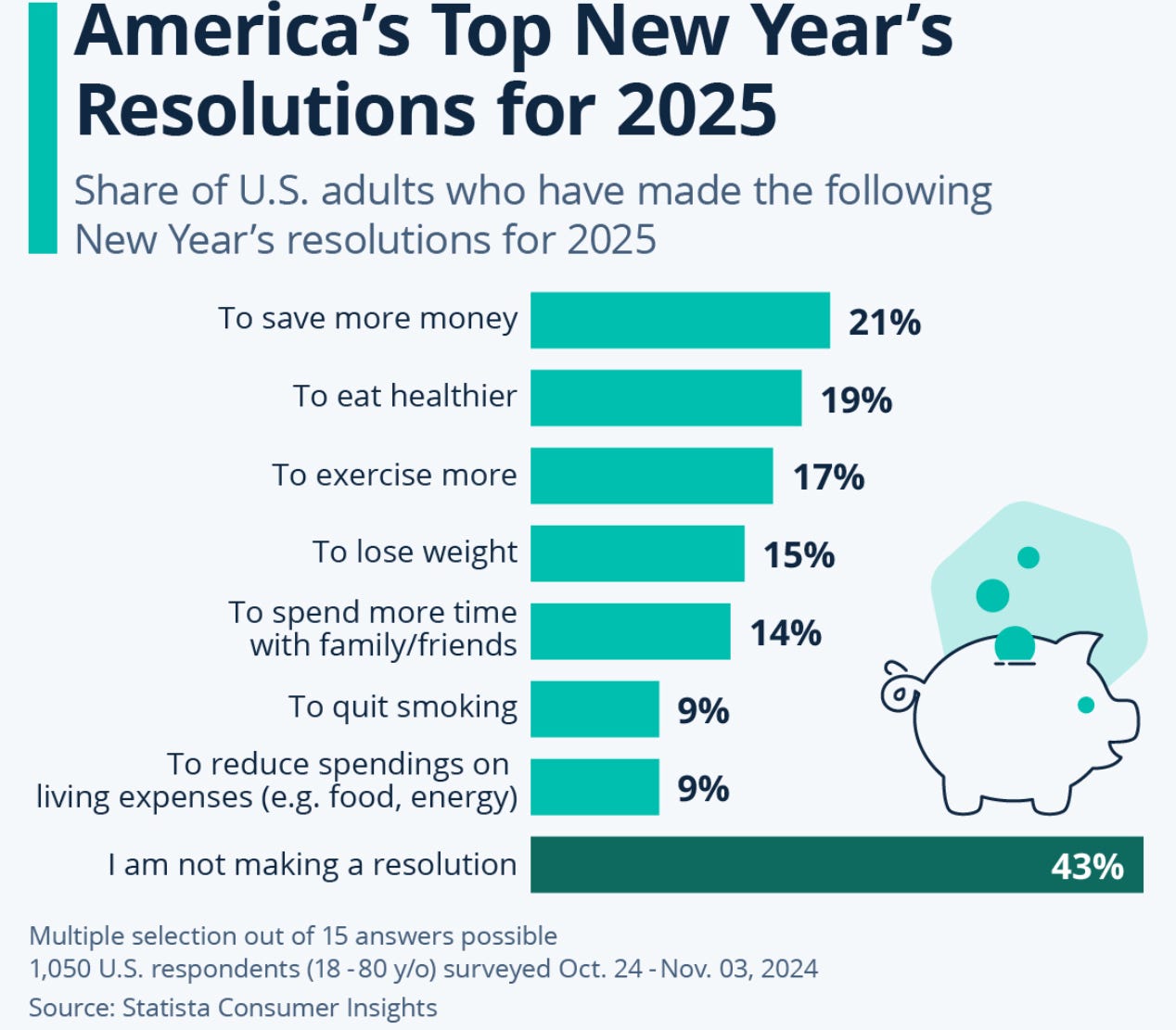
Of those folks who made a New Year’s Resolution when the ball bottomed out last week (God bless those 43% of people who just opted out), the vast majority of their commitments are related to numbers.
Enter an entire industry meant to help us observe and document our existing behavior. These trackers make it wholly unnecessary to identify any patterns on our own; the AI does that. The app also has the next step covered, interpreting the data on our behalf and providing recommendations about what we should do next…the hypothesis, so to speak. All of this is tied to a goal we are prompted to input before the tracking even begins, a self-identified benchmark against which to measure our progress and, importantly, justify the continued payment to said device’s app subscription.
It is human nature to want to know more about ourselves, particularly when we think there is an arbitrary gatekeeper that might be withholding access to this coveted data. We assume that if only we had the data, something, if not that one thing, might change.
I say “We” not as some bullshit means of making you feel less naked under your Apple watch and your Oura ring. I see your tracker and raise you mine.
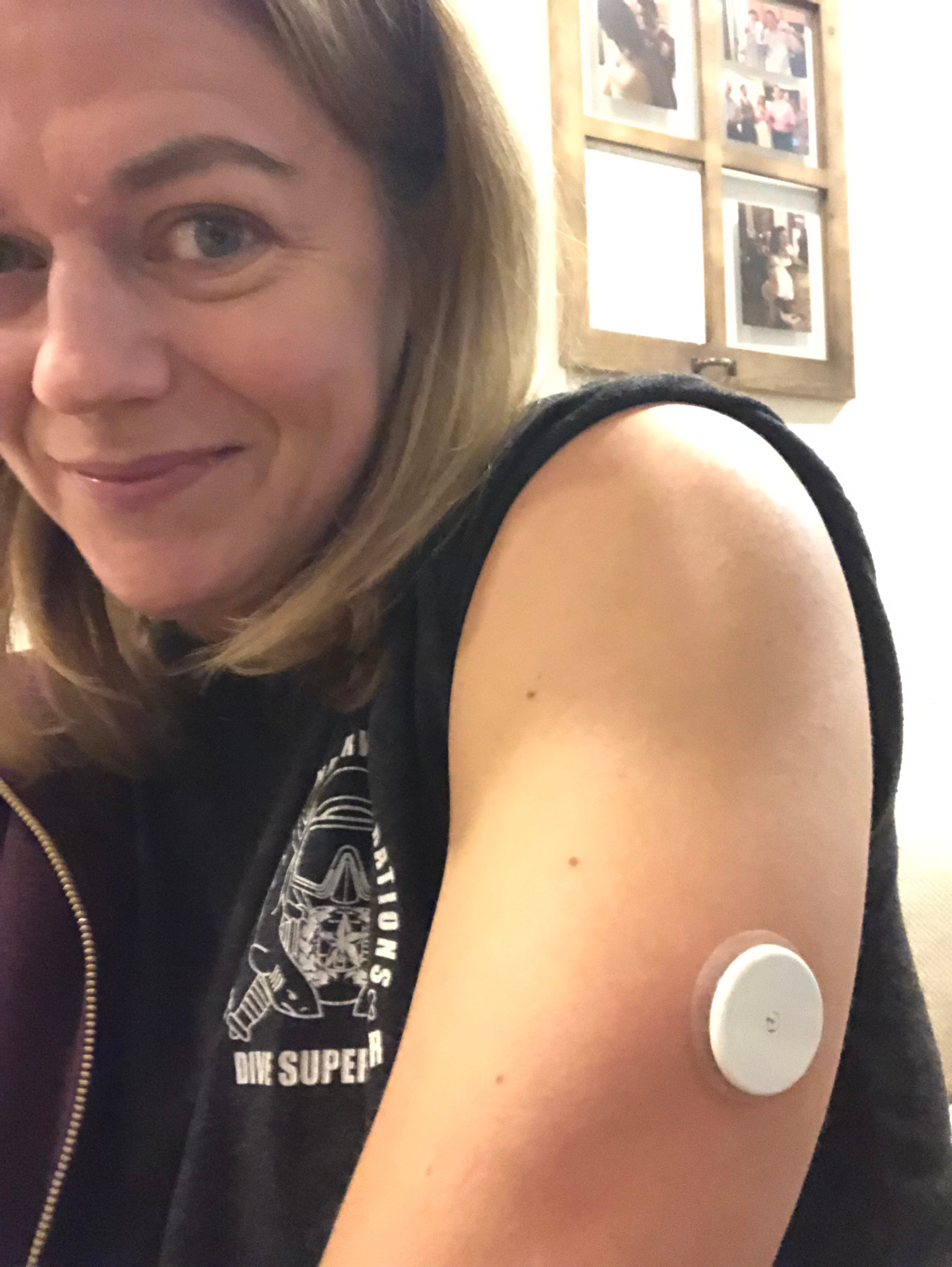
That, my friends, is a Lingo. A continuous blood glucose monitor.
No, I have not developed diabetes during Christmas vacation, although that’s a minor miracle in and of itself. But Abbott has decided blood glucose information should be readily available to all people, and I, for one, agree.
I have developed a minor obsession in the approximately 2.6 days I’ve been wearing this thing. Watching my blood glucose adjust in real time to what I eat, when I exercise, or even just waking up is literally fascinating.
You wanna see my graph from yesterday? You know you do…
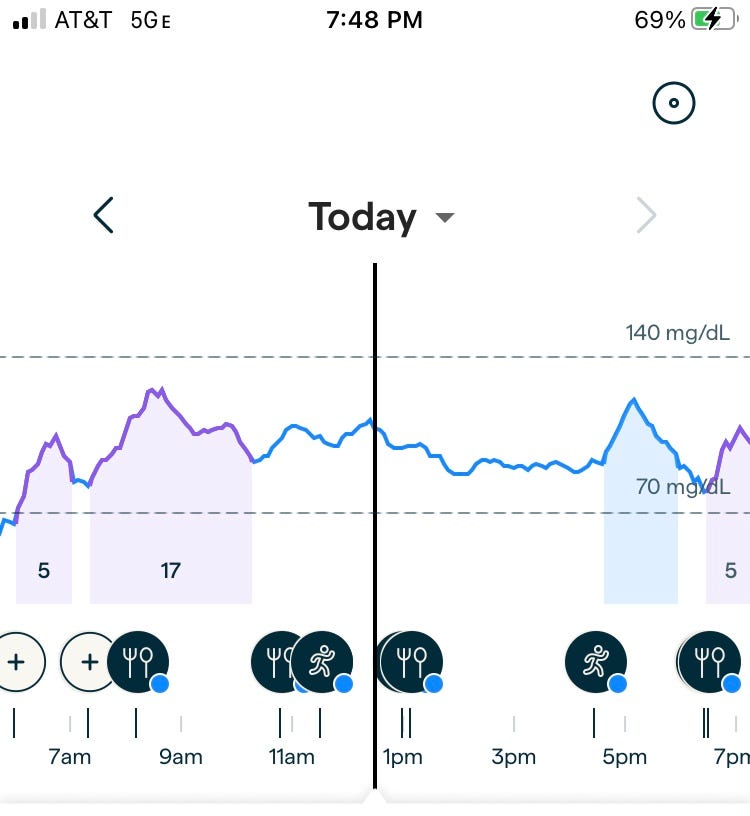
Now I admittedly do not have a New Year’s resolution tied to my Lingo. The decision to monitor my blood glucose came after a significant amount of research about what the fuck might be going on with my premenopausal body. Oh, and the simple knowledge that one could actually do this without a prescription or diagnosis, a fact that is frustratingly withheld by our healthcare system (rant for another day paused).
What I do have is good old fashioned curiosity. And slightly misplaced hope. I want this data to mean something. I need it to mean something. See, my body and I don’t communicate well. She speaks some incomprehensible mix of Japanese and Minion, and I, well, I largely just bark orders at her in my head.
Lingo has been hired as my interpreter.
Step 1 has just begun (reference bastardized scientific method above)! We are now actively observing my behavior. And documenting it. Apparently, after one more day, my interpreter is going to look for patterns and draw preliminary conclusions. Then, I get to do my favorite part. Create and test a hypothesis. My body looooooves it when I do that. Seriously, she’s a fan.
NOT.
But we’re going to do it anyway because who asked for her opinion? I can’t understand her regardless, so she can bitch me out in gibberish all she wants, but I’m not going to stop until I see that graph give me a nice, even set of rolling hills. No peaks. No valleys. Just steady.
That’s when she will be at peace.
So says the app.
Am I really planning to use this data to make changes to my diet, exercise, or sleep habits?
Maybe. Maybe not.
See, I already know what needs to happen. I’ve done all the research. I’ve read about the insulin pathway and how its triggered by carbohydrate exposure and why that makes you store fat. I’ve scoured the internet for publications unveiling the toxic effects of processed foods and editorials demonstrating the financial mouse trap that has organizations designed to protect us putting endorsements of health on Coco Puffs.
The conclusions are clear. The data unequivocal.
So why Lingo?
Because I have a dirty little secret…
The data makes me happy. It brings me joy.
I like proof of my success, evidence that I’m doing a good job. Fuck a badge or exploding cannons or a digital high five. That does nothing for me. But watching that chart flatten out, staying within the boundaries, knowing my body and I are finally fighting the same war on the same side? Well, that’s just intoxicating.
There’s truth in data, yes, but there’s also the opportunity for joy. When we become obsessed with the numbers themselves instead of their progression or their purpose, we siphon off the joy, forgetting that data is not meant to hurt, just to help. It is simply a reflection of what is, not what matters. We ascribe value to the numbers. We give them meaning. We draw the conclusions.
What we say to ourselves about our numbers is the interpretive equivalent of statistical significance.
What it need not be is the limitations. Let us not interpret the data in such a way that our list of shortcomings, impediments, restraints outweigh the value of our conclusions.
If that’s how you’re using your data this new year, please throw your device away. NOW!
Science is inherently the study of wonder. A joyful exercise in expanding our understanding of the natural world. It is meant to delight. To fascinate.
Not to destroy.
If I can offer one New Year’s resolution, may it be to find joy in your numbers. Or at least the process of acquiring them. Let them be what they may be. You assign them significance. And if the app disagrees with you, tell it to shut the fuck up. It only speaks Minion anyway.
Reading this remind me of what kindred spirits we really are, Jess. I have both a t-shirt and water bottle sticker that say, "Nice story. Now show me the data." And, of course, you now... My CGM is my life. Literally. 🤗 I'm glad they're accessible to all now!
I love your approach, and who knew this was something mere mortals could do (without a prescription or diagnosis)? I am also realizing, based on your “confession,” that I also love the data. I like to understand the input, output, and variables, but I never thought about it in quite those terms. Interesting. Thanks for bringing us along on your journey!