
Legacy Lasts Forever
How will they remember you?

“He’s the strongest man I know.”
My Dad’s voice was shaky on the other end of the phone. He and I are not close, but you never forget the timber of your father’s voice, nor the tremble when emotion threatens to overtake it. The shock resonated through my body, ricocheting around my pectoral cavity as my brain scrambled for dominance over my heart.
My grandfather, Dr. Gene Hooks, or “Grandaddy” to me, lay before his son, unable to speak, to recognize, to engage. Ten days ago, he had a black toe and a plan to invite everyone he wanted to say goodbye to to his month-early birthday party. Just like him to run the invitation list to his own pre-funeral shindig. He knew his time was short, but he was going to execute it the way he lived…on his terms.
Today, he is actively dying.

I am usure if I have the words to describe my grandfather. It is possible he is truly indescribable. For my entire life, he was the benchmark, the litmus test by which every member of my family held themselves accountable. I made him angry only once that I know of, and the retched taste of his disapproval soured my soul. I would not make that mistake again.
I have instead spent my entire life trying to make him proud of me.
That is not an easy feat, or so I thought. When I turned down a full scholarship to the University where he dedicated almost thirty years of service, I fretted that I had fractured my relationship with him forever. I accepted a full scholarship to another school, a semi-rival school, and it was he I was most afraid to tell about this decision. I couldn’t bear the weight of wondering for my entire college career if any accolades I accumulated were truly my own, or an extension of his, bestowed upon me if not at his behest, then as some assumed expectation of taking it easy on the next generation. I needed to make my own name, not live under the ease of his.
Turns out, my fear was unfounded, because he apparently admired my moxie in electing not to live in his shadow but to make my own shade. On the night that I introduced Mahatma Gandhi’s daughter to a sold out crowd, an honor earned by my efforts to bring her message of peaceful protest to campus following 9/11, he was in the audience. After the talk, I expected praise for this monumental undertaking by a then 20-year old. Instead, walking behind me back to our cars, he grabbed my shoulders and jostled them into position. “Shoulders back, head high,” he said. He then made me turn and shake his hand. “No,” he said, clearly frustrated, “shake my hand like you know you’re meant to be here.” I practiced in the parking lot, shaking his hand and meeting his eye until he was satisfied. He said nothing else.
At the time, I was devastated. And frankly, dumbfounded. How was that the treatment I received after such an obvious moment of Hooks’ worthy success? How could he not be proud of me?
Decades later, I see recognition in his reaction. Acknowledgement that his granddaughter was bound for a bigger stage and that stage would require strong shoulders and a definitive handshake, particularly because I was a woman. Had he not been proud of me, he never would have bothered to help groom me. But in that moment, because of that stage, he knew I was determined to barge into any room, even those where I was uninvited, and he was determined that I not show up unprepared.

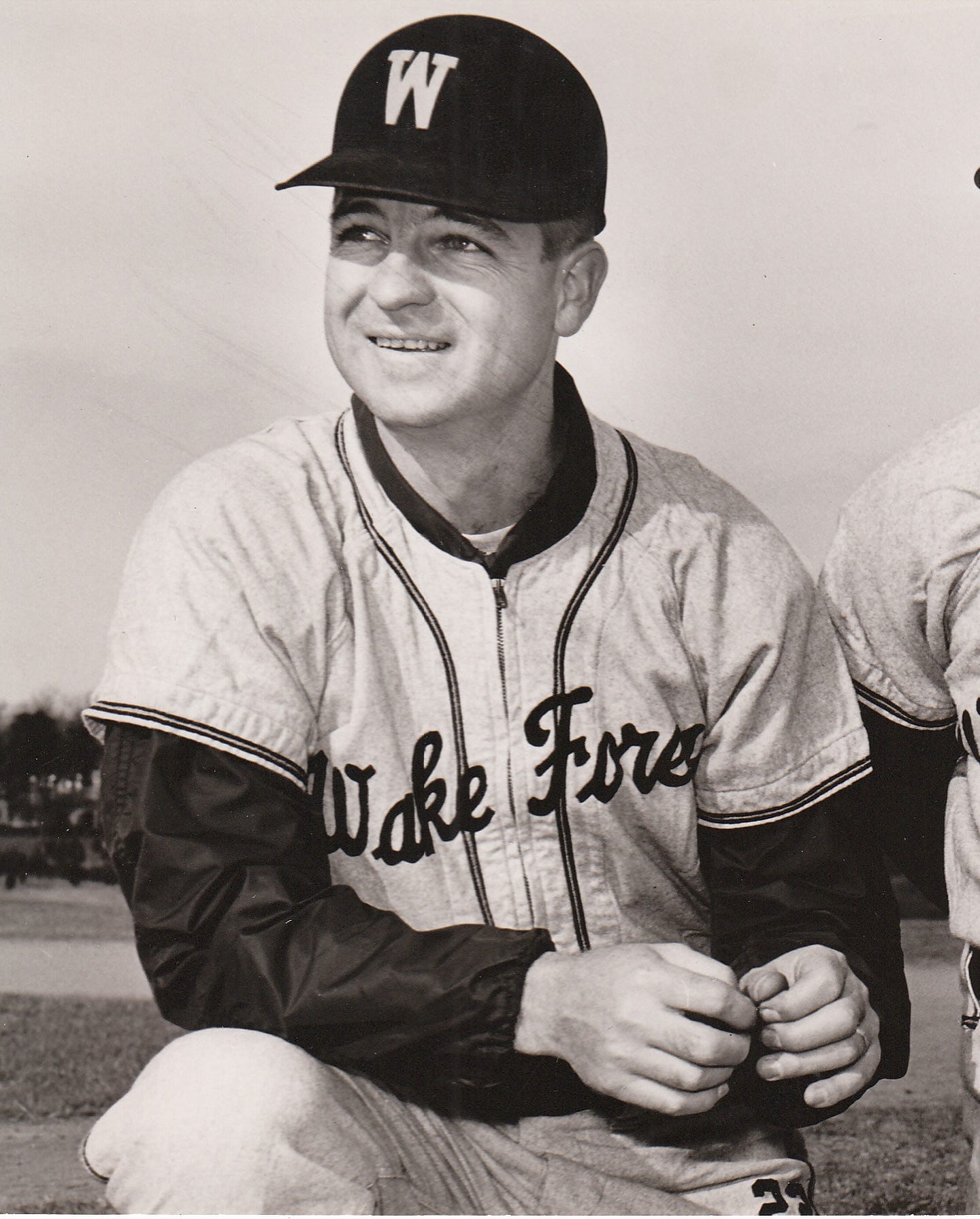
My grandfather was a professional baseball player. A third baseman, he was a standout at Wake Forest University in the late 40’s after his military service ended just shy of a deployment to WWII. He went on to play for the Reds organization and then the Cubs, taking his young bride, my grandmother, with him. He threw out his rotator cuff, ending his career in the Majors in 1954, but he returned to North Carolina to get a Master’s Degree and then, ultimately, a PhD in Physical Education. He came back to Wake Forest, first as a PE Instructor, then as part of the baseball coaching staff, and ultimately, as Athletic Director. For 28 years he held that post. It was his life’s work.
It was a magical way to grow up, the granddaughter of the Athletic Director and the only girl in a family full of boys. I tagged along behind my grandfather at halftime of every home football game, dressed to impress in my WFU cheerleading uniform. His staff doted on me, covertly shoving strawberry hard candies into my grubby little hands and prying me with glasses of lemonade. Upon his retirement when I was thirteen, I could not understand why anyone would want to attend a football game and sit in the stands. My spoiled version of sports spectatorship involved press boxes, brownies, a television, binoculars, and my own bathroom.
It also involved my grandfather. A patient, principled, perceptive man who was adored by everyone around him. He delighted in me, and he expected much of me. He paraded me around at halftime both to entertain me and to prepare me. He knew I was watching his way with people, how he worked a crowd, noting the appropriate time to smile, to laugh, to shake a hand, or turn a shoulder. He was magnanimous with his attention, and there were many eager to receive it.
I had no idea what he actually did for a living, but I knew that he was important. And loved.
I later learned that love was well-earned. My grandfather was a trailblazer. A consummate mentor. If he demonstrated you deserved a shot, he gave it to you, but you only got one. Tens if not hundreds of careers were built off his willingness to give someone a chance and an entire sports era was dominated by his determination to do things the right way, with integrity, even in an increasingly demanding NCAA environment. He wanted to win, and he never believed in participation trophies, but he cared about how you won, not just if you did. He didn’t tolerate cheating, quitting, or taking the easy way out. You wanted it, you earned it. Period.
He was inducted into the Wake Forest University Sports Hall of Fame in 1994.
The North Carolina Sports Hall of Fame in 1999.
And the College Baseball Hall of Fame just this past January, as part of the Class of 2025.

I have never wondered what a “good life” looks like. My grandparents embodied it. Married for 63 years until her death in 2015, my Grandaddy and Grandmother showed us what it meant to work hard, to love deeply, to demand excellence, but to forgive failure. They were not wealthy, but they could afford all the Breyer’s ice cream a garage freezer could hold and that was as good as rich in my book.
When my grandfather turned 90 almost nine years ago now, I had the idea to document ninety memories I had of him throughout my lifetime. When I began writing them down, I was worried I wouldn’t be able to come up with the full 90, that I’d need to fudge a few to round out the count. But by the time I finished, I realized I could have easily doubled that number. When I gave my Grandaddy the memory book, I was afraid he wouldn’t understand its significance, what I was trying to tell him about his impact on my life. He thumbed through the first few pages, reading slowly, intentionally. The man could never be rushed for a reaction. Eventually he looked up, tears filling his eyes. He wiped at them with his thumb and forefinger. And he thanked me. Not the thank you of an elder to a child, but the thank you of a man who need no longer wonder whether his legacy is secure.
Two months ago, I got a text from my brother. It was a video. No accompanying words. Rolling my eyes at his consummate lack of communication, I hit play…
That voice.
Every lesson he’s ever tried to teach me. Every emotion he’s tried to share, the smell of the dirt on the field, the schwack of the ball as it hits the mitt, the electricity in the lights under an indigo sky. Baseball was his metaphor. His poetry. And he spent his life asking all of us to join him on the mound. To look around. To inhale deeply. To express gratitude. To care more about “we” than “I.” To do things the right way not the easy way. To practice the small stuff. To perform. To compete. To fail. To get back up. To try. To win. Together.
Over and over and over again.
Legacy lasts forever.
I will cry every time I watch this. Forever. And I will spend the rest of my life trying to answer his final question…
“How will they remember you?”

My grandfather, Dr. Eugene Gaylord Hooks, passed away on April 6th, 2026. He was ninety-eight years old.
Thank you for sharing. All my grandparents are gone and I know we are part of their legacy.
Jess, you said you were unsure if you had the words to describe your grandfather, but what you wrote here pulled me in to feel so much in my expanded heart. I feel so much adoration for this special man and the good he generated in his big life. I am so sorry for your loss of him, and I can feel that loss too from learning from just this page. When it comes right down to it, this is what we want in life- this kind of connection he had to what really matters, and passing on to others "caring more about we than I"- all that you absorbed having him guide you as you grew, truly impactful. Thank you for sharing him with us.