
You Get to Choose When You Stop Digging
A conclusion to the Worst Day/Best Day/Define you debate...

“Your rock bottom is when you decide to stop digging.”
I could stop the article there. I mean, honestly, isn’t that one line enough for you today? I have said it so many times, it’s started to become some sort of mantra.
I whisper it when I’m running.
I stare at it in my notes and let the sound of it roll around my mouth.
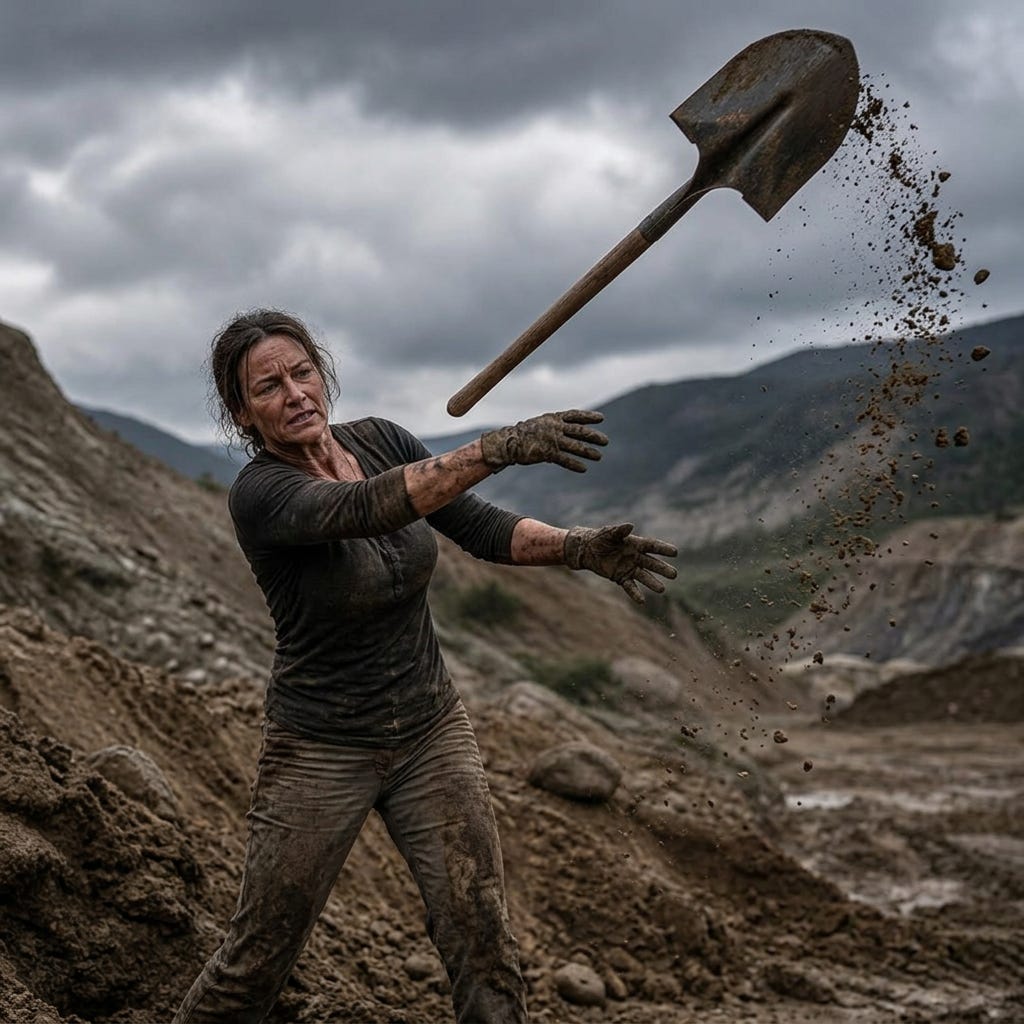
I lay in bed visualizing myself with a shovel.
What those words would have meant to me if I’d heard them when I was at the bottom of my own canyon, when Joy was laying next to me trying to coax me to look up, but my neck was permanently bent towards the rocky, dusty floor.
It is no accident that I heard that line from someone whose worst day rivals my imaginative capacity for worst days.
He is one of our authors.
He is, in fact, the only author whose book we’ve ever published where the worst day is not the consequence of something that happened to him, but instead because of him.
Twenty-three years ago, Martin Lockett killed two people.
The 24-year old was drunk after partying for most of the day and all of the night. It was New Year’s Eve, yes, but that was not unusual behavior for him at the time. In his inebriated state, he ran a red light. Intentionally…not by accident. It was his judgment, not his reflexes, that were impaired.
And because of the decisions he made on that day, particularly that final decision, Martin went to prison.
For 17 ½ years.
For most of us, that’s where the story naturally ends, at least the one we know about. Drunk driver, fatal accident, prison sentence, justice served. The sound of the bars clanking together the ring tone of a person hitting rock bottom.
Except, what if that wasn’t Martin’s floor? What if he kept digging?
“What I didn’t understand then was the difference between accountability and self destruction.”
Martin has never made excuses for his actions, never tried to sidestep responsibility. In fact, he always refers to the collision as “the crash” as he owns that there was no accident in his inebriation. But how do you pry the shovel from your fingers with the weight of that worst day on your back?
It’s the part that fascinates me about Martin’s story. The point where he decides to let go, slowly at first, individual fingers loosening their grip and then all at once, the shovel clanging to the concrete floor as he both rejects shame, “I am wrong” and accepts guilt, “I did wrong.” In that differentiation, he found a seam of opportunity. A tiny crack to begin building instead of destroying.
Martin dedicated his life to ending drunk driving. In prison, he earned a GED, then a Bachelor’s degree, and a Master’s. He started a blog and wrote two books. He taught fellow prisoners math and became a tutor in a literacy program. Since his release, he has landed a full-time job at an organization that helps people with substance abuse issues. He travels the country talking to high school assemblies and college conventions about the consequences of drunk driving. And most importantly, he has remained sober.
He made good on the promise he made at his sentencing hearing. That the lives of the two people he killed would not be in vain. His conscious choice to amalgamate the tragedy and the transformation is some abstract art that forces you to stare at the pain in order to understand the beauty.
There is a day that defines Martin, but it is not his worst day.
It’s the day he decided to stop digging.

I’ve been on a mission with this worst day/best day thing. It’s become a slight obsession likely because every question I’ve asked of myself and of you seems to beget more questions. I used to hate those kinds of conversations. Philosophical wanderings that ate up time, had no practical application, and scratched some esoteric itch of those corner and window people. I’ve always been a walls and doors kinda gal. Give me ninety degree turns on the journey of life; wandering is not my way.
And yet.
The questions weren’t just in my own head. They teased you too. You reached out to tell me so. I realized that I know so little about the days that define many of the people closest to me. And that the same is true of you…with me.
Until I talked to Martin, I legitimately feared this would become a series I had to abandon. Because the questions kept coming without answers. A K-hole opening somewhere in the Universe that we were all dangerously close to being sucked into as I succumbed to swirling in the unknown unknowns. But the Universe is a kind and benevolent place at times and ultimately knows I hate K-holes.
Where people got stuck, where I got stuck, is in tracing how someone’s worst day and best day defined them. That word, “define,” carries meaning for each of us that is nuanced and charged. And if taken literally, there does seem to be a gap between worst day and the definition of the person on the other side. And now I know why.
Because what defines us is not the day itself. It’s not whether we find ourselves at rock bottom or on top of the mountain. It’s what we choose to do with the shovel we’re carrying when we get there.
Dig or build?
And as I look at the people around me whose worst days have fueled something meaningful, something generous, something affirming, it is because they have all, eventually, given up on digging.
“Our darkest times can always be lit up by the fire we bring to it.”
It makes sense. Joy is not into manual labor. Her idea of a good time is not excavating a rock quarry. She will never be the one to hand you a shovel.
But if you want to leave something. If you want to create something. If you want to become something, Joy will be the first to say, “I believe you can.”
To some of you, this may seem like an obvious conclusion. Of course what happens next matters, but it is the crux of that conscious choice that I was chasing. The question became about the inevitability of the outcome, was your worst or best day destined to define you or was there something else.
Turns out, there was. It is your commitment to digging.
We don’t get to pick our most extreme days; that’s another part of the equation I struggled with. The control freak in me does not appreciate being fodder for the Universe’s experimentation. But, helplessness assumes our hands are glued to the shovel. Agency suggests we have options with how we choose to use it.
There is hope in that.
I have learned through writing this series that Joy is always above us, and if you’re headed up, she will often walk with you. I trust that now.
But I remember what it felt like to have a broken neck, to be incapable of looking up. I needed hope to break that spell, to remind me that there was something above me.
And so how, when you are face down, do you find hope?
You throw down the fucking shovel.

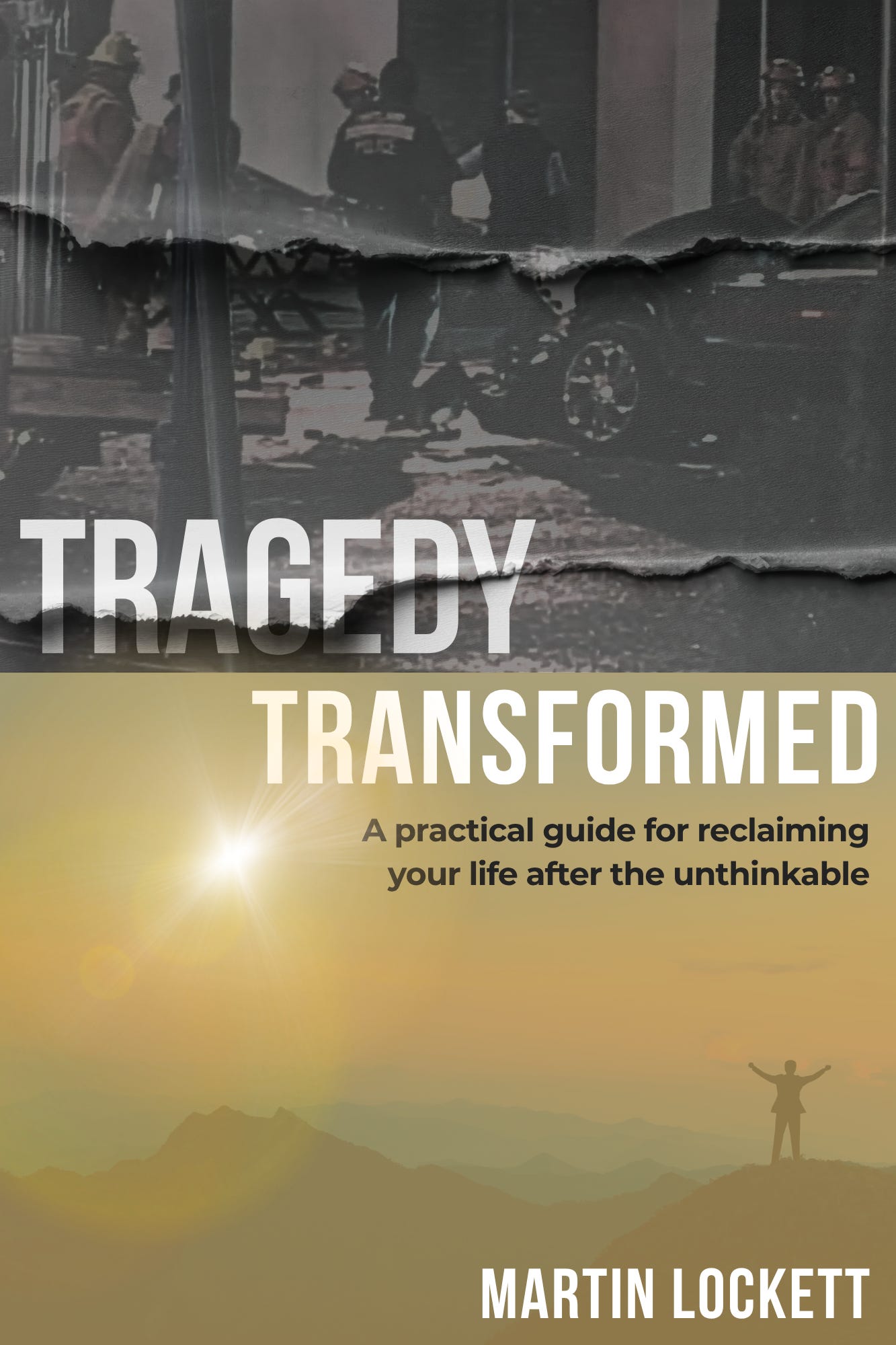
I am so grateful to Martin for saving us all from the K-hole, but I am even more grateful that he trusted us, Atlas Legacy Press, to publish his story. We have built a business of sharing stories of how people have turned their pain into purpose, but this one is different. And it reminds me that pain can be self-inflicted and purpose can be manifested.
Tragedy Transformed comes out this November. I hope you’ll keep an eye out for it.
I so agree with you, Jess - it’s not the event or series of events, it’s what we do as a result of that experience. Martin’s life is a powerful and inspirational illustration of that.